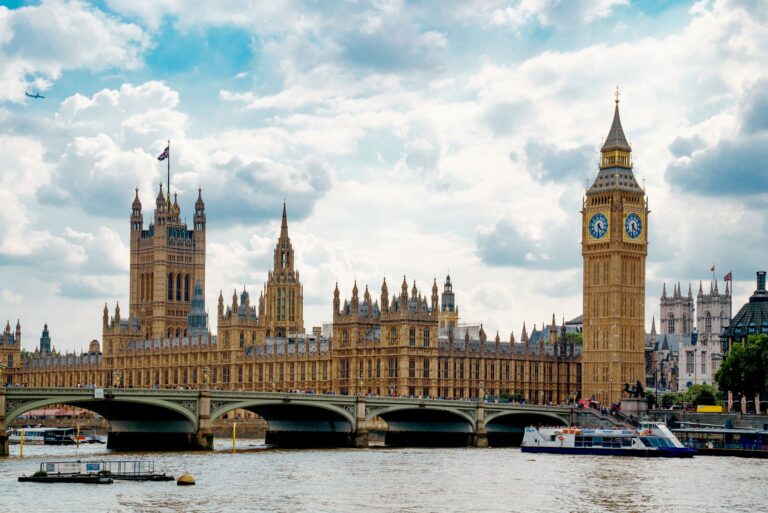

UK economy and politics take centre stage at UKICE Lunch Hour
The relationship between political uncertainty and economic performance sat front and centre this week as the UK in a Changing Europe (UKICE) hosted its latest Lunch Hour event, drawing together economists, policy analysts and senior researchers to pick apart what’s really driving the UK’s sluggish growth numbers.
A difficult economic picture
The UK economy grew by just 0.1% in the final quarter of 2024, a figure that hung over the discussion like a storm cloud. Analysts at the event pointed to a combination of weak business investment, persistently high borrowing costs and consumer confidence that still hasn’t fully recovered from the inflation shocks of 2022 and 2023. It’s not a crisis, panellists stressed, but it’s not healthy either. And the gap between the UK’s performance and that of comparable European economies is becoming harder to ignore.
One senior researcher put it plainly: “We’re in a holding pattern. Businesses aren’t collapsing, but they’re not betting on the future either. That’s the real problem.”
Politics adding to the uncertainty
Much of the session focused on how domestic political decisions are feeding directly into economic outcomes. The government’s October 2024 budget, which raised employer National Insurance contributions by 1.2 percentage points, drew considerable scrutiny. Several speakers argued the move had spooked small and medium-sized employers at exactly the wrong moment. Hiring intentions in the SME sector dropped notably in the months following the announcement, according to figures cited during the event.
Still, defenders of the budget argued it was necessary to stabilise public finances after years of drift. The debate wasn’t settled — it rarely is at these sessions — but it reflected a genuine tension inside economic policy circles right now.
The EU trade relationship looms large
Brexit didn’t leave the room. Researchers presented updated modelling suggesting UK goods exports to the EU remain roughly 15% below the trajectory they’d have followed had the UK stayed in the single market. Services tell a different story, with some sectors adapting better than expected. But the overall drag is real, and UKICE researchers were direct about saying so.
The question of whether the current government will pursue a closer trading arrangement with Brussels — sometimes called a “reset” — came up repeatedly. So far, concrete movement has been limited to a handful of agreements on data adequacy and veterinary checks. Meaningful structural change looks unlikely before 2026 at the earliest.
What comes next
The mood wasn’t entirely grim. There was genuine interest in the UK’s potential in clean energy investment and life sciences, sectors where government commitment has at least been consistent. But analysts warned that good intentions won’t translate into growth without stable regulatory frameworks and long-term spending commitments that survive political cycles.
UKICE plans further Lunch Hour sessions throughout the spring, with the next expected to focus on trade policy ahead of any potential UK-EU summit later this year.